

Leadership
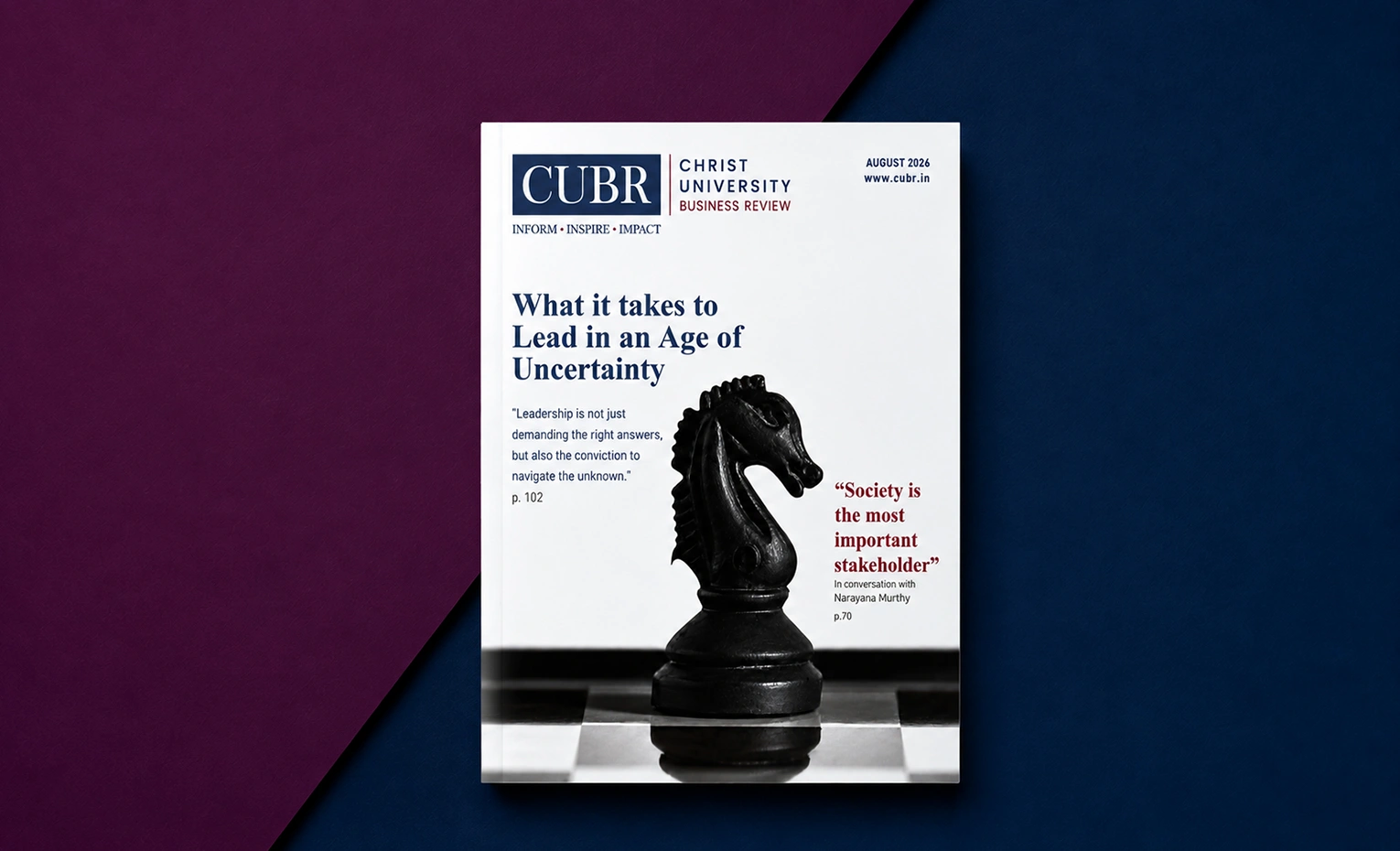
Future-Ready Leadership: What it takes to Lead in an Age of Uncertainty
Leadership is not only demanding the right answers, but also the conviction to navigate the unknown.

The Quiet Collapse of Command: Leading Without Hierarchies
Leadership without hierarchy is not the absence of a leader; it is leadership that is earned through expertise, trust, and shared responsibility.

From Intuition to Intelligence: What Drives Decisions in the Predictive Analytics Era
Data can predict decisions, but not take responsibility. In the age of predictive analytics, algorithms can influence decisions, but humans define them.

September 2026
Business Review Magazine
From Intuition to Intelligence: What Drives Decisions in the Predictive Analytics Era
Digital Articles Articles
As predictive analytics becomes an integral part of decision-making, organisations are entering an era where data-driven insights increasingly influence strategic choices. Predictive models are now forecasting future outcomes rather than merely reporting past performance. This development has enabled businesses to improve planning, operational efficiency, and competitive advantage.
There is a pressing need for analytical literacy, ethical leadership, and governance mechanisms that keep people accountable for decisions shaped by AI. While analytics offers opportunities across functions such as supply chain management and human resources, it also presents potential risks if organisations over-rely on algorithmic recommendations. Issues such as automation bias, algorithmic discrimination, and ethical accountability underscore the importance of having manual supervision over high-impact decisions.
Through real-world examples, the article demonstrates how successful implementation depends not just on the advancement of technology, but on the quality of leadership, organisational culture, and decision-making frameworks in place, in order to ensure accountability and long-term organisational resilience.

Future-Ready Leadership: What it takes to Lead in an Age of Uncertainty
Digital Articles Articles
In an era of rapid technological shifts and changing stakeholder expectations, leadership has evolved from being a role that simply maintains organisational stability to one that navigates complexity with purpose. The primary quality that distinguishes future-ready leaders is the ability to combine digital fluency with human-centred leadership. Organisations that aim to sustain in an era dominated by AI must focus on leadership that thinks systematically, adapts in real-time and prioritises innovation and ethics in decision-making.
Digital literacy, adaptive agility, collaborative leadership, emotional intelligence, and long-term strategic thinking have emerged as essential capabilities for leading through uncertainty. Organisations are increasingly replacing conventional leadership training methods and focusing on building resilient leadership by investing in continuous learning, cross-functional exposure, and experiential development. In the contemporary world, leadership is measured by the ability to foster a sense of trust and collaboration, while also aligning business performance with stakeholder expectations and sustainability goals.
The article states that future-ready leadership is a strategic capability that embeds adaptability, ethical decision-making, and continuous learning into the leadership culture. Organisations that promote such leadership merits will be better positioned to navigate disruption, drive innovation and create sustainable value in a highly interconnected and technology-driven business landscape.

The Quiet Collapse of Command - Leading Without Hierarchies
Digital Articles Articles
As organisations confront faster innovation cycles and increasingly knowledge-driven work, the conventional ‘command-and-control’ structures are being challenged. Traditional hierarchies are giving way to more agile and collaborative leadership models that function by prioritising expertise, trust, and shared responsibility. In such a radically changing professional landscape, the ideal way for flatter organisations to survive would be to redistribute leadership to those better suited to make decisions rather than eliminating it entirely.
Non-hierarchical leadership would thrive in environments that foster psychological safety, shared purpose, transparent accountability and clear decision-making. However, there are limitations to non-hierarchical structures, such as role ambiguity, undefined conflict-resolution mechanisms, and the absence of inclusivity, which are a few issues that organisations without formal hierarchies struggle to navigate. The article demonstrates that flat organisations are structured through intentional design using examples from healthcare and technology sectors.
Therefore, the future of highly functional organisations lies in hybrid structures that simultaneously reap the benefits of the agility of distributed leadership and the clarity of selective hierarchy. As workspaces become increasingly collaborative and AI-driven, organisations seek leaders who can command credibility, enable cross-functional coordination, and develop cultures where shared purpose becomes the foundation of the organisation.

Start Your
Subscription Journey
Get full access to exclusive content, updates, and features by starting your subscription today. Stay informed and enjoy uninterrupted access anytime, anywhere.
Start my subscription!